
Collision Center 1 Golden Valley Explains How Auto Body Repair Addresses Damaged and Misaligned Panels
Golden Valley, MN - October 07, 2026 - PRESSADVANTAGE - Collision Center 1 Golden Valley is publishing consumer
Press Release Disclaimer: This is a press release distributed through the XPR Media network. It has not been independently verified by our newsroom.

Golden Valley, MN – October 07, 2026 – PRESSADVANTAGE –
Collision Center 1 Golden Valley is publishing consumer guidance that gives drivers a four-part framework for understanding how damaged or misaligned exterior panels are evaluated and repaired after a collision. The October resource focuses on identifying the cause of changed panel fit, deciding whether a component can be repaired or requires replacement, restoring panel position, and completing refinishing and reassembly.
Information about the facility is available through the Collision Center 1 Golden Valley location page.
The first part of the framework is identifying why a panel changed shape or position. A collision may leave an obvious dent or crease, but drivers may also notice a door sitting differently in its opening, a bumper corner separating from a fender, or a hood with an uneven gap.
A changed panel gap does not by itself establish structural damage. The cause may involve the exterior panel, a hinge, bracket, retainer, latch, mounting point, or adjoining component. Determining which component was affected provides the basis for developing the repair plan.
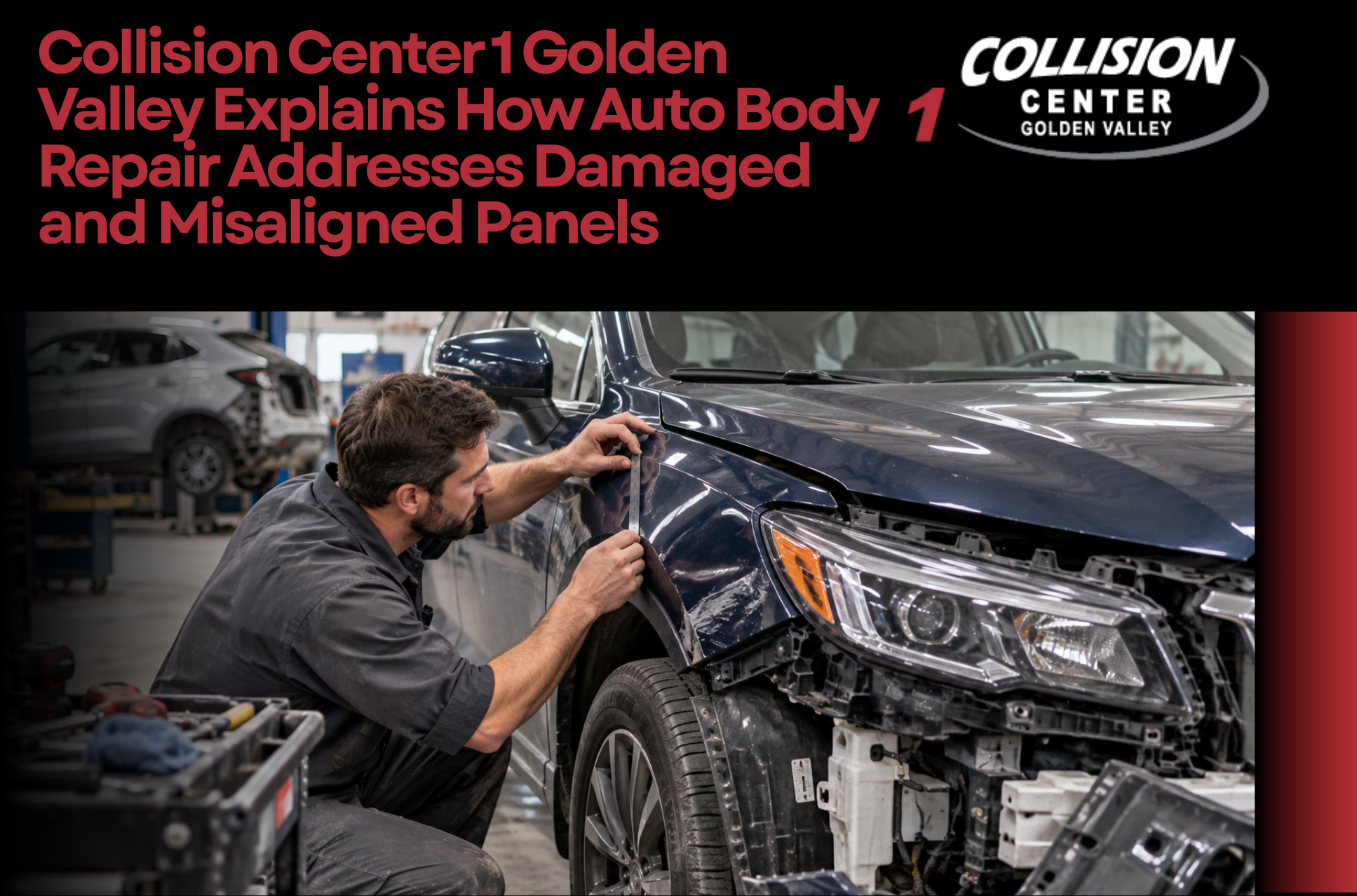
Doors illustrate this process. Following a side impact, technicians can consider the visible door damage along with its relationship to the surrounding opening. Changes in how the door opens, closes, or latches can provide additional information about hinges, mounting areas, latches, and neighboring components.
The same principle applies to hoods, fenders, quarter panels, bumpers, trunks, and liftgates. A visible alignment change is treated as information about the affected area rather than as a diagnosis on its own.
The second part of the framework is determining whether the damaged component can be repaired or needs replacement. Through the auto body repair process, factors such as panel material, damage location, deformation, accessibility, finish condition, and applicable repair procedures can be considered.
Not every damaged panel requires replacement. Some dents and deformed areas may be suitable for conventional body repair. Certain dents may also qualify for paintless dent repair when the finish remains intact and other repair conditions are appropriate.
Damage involving sharp creases, compromised paint, stretched material, difficult access, panel edges, or more extensive deformation may require a different approach. The repair decision depends on the condition of the individual component.
Bumper alignment can require similar evaluation. A bumper cover is positioned by tabs, brackets, retainers, and other attachment components. If a bumper corner pulls away from a neighboring panel after an impact, technicians can determine whether the cover itself, an attachment point, or another part of the assembly caused the change.
The third part is restoring the physical shape and position of affected components. Repairable panels can receive body work appropriate to their condition, while components identified for replacement can be handled according to the repair plan.
Panel relationships can be checked as work progresses. A fender involved in a collision, for example, needs to relate appropriately to surrounding components such as the hood, bumper, lamp, and door. Paint cannot correct a component that remains physically out of position.
Vehicle construction can influence how this work is performed. Different vehicles can use steel, high-strength steel, aluminum, plastics, composites, adhesives, welds, rivets, and other joining methods. Applicable manufacturer repair information can therefore guide procedures for the specific vehicle and component.
The fourth part covers refinishing, reassembly, and final review. Once applicable body work or component replacement is complete, repaired surfaces can be prepared and refinished. Depending on the finish and repair area, blending into an adjoining panel may also be part of the refinishing plan.
Components removed for repair access are then reassembled as applicable, allowing affected panel relationships and operation to be reviewed again. The broader collision repair process connects these steps with damage analysis, repair planning, parts coordination, and final review.
Modern vehicle technology can add procedures when equipment is located within the repair area. Depending on the vehicle, cameras, radar equipment, parking sensors, wiring, or lamps may be positioned around exterior panels and bumper assemblies. Not every panel repair requires diagnostic or calibration work. Any additional procedures depend on the vehicle, affected components, work performed, and applicable repair documentation.
For drivers, the October guidance provides a concise way to understand panel repair: identify what caused the change in fit, determine whether the damaged component is repairable, restore the physical position of affected parts, and complete the appropriate refinishing and reassembly.
The main takeaway is that correcting collision-related panel damage involves more than making an uneven gap look uniform. The underlying component or attachment responsible for the change needs to be identified so the repair can address both visible damage and panel fit.
Collision Center 1 Golden Valley is located at 900 Florida Ave S, Golden Valley, MN 55426. The facility provides auto body and collision repair services for Golden Valley-area drivers as part of Collision Center 1.
###
For more information about Collision Center 1 Golden Valley, contact the company here:
Collision Center 1 Golden Valley
Jerald Stiele
(763) 541-9727
layres@collisioncenter1.com
900 Florida Ave S, Golden Valley, MN 55426


